notes
Zettelkasten Explained Simply: How a Network of Notes Generates Ideas
The gist: Niklas Luhmann turned roughly 90,000 handwritten index cards into a network that helped him write dozens of books and hundreds of papers — not because he had cards, but because he’d built a web of notes that surfaced connections on its own. The method’s core is simple: write atomic notes (one idea, its own title), keep fleeting, literature and permanent notes separate, and link them to each other. You don’t need paper cards or a ritual — it works in any note-taking app, including the one you already use.
Niklas Luhmann was a German sociologist who built one of the most influential social theories of the 20th century — and, alongside it, an archive of roughly 90,000 handwritten index cards he called his Zettelkasten, literally “slip box”. Out of that archive came dozens of books and hundreds of articles, often written at a startling pace. Luhmann himself described the box as something close to a conversation partner — almost a second author, handing him connections he wouldn’t have found on his own.
That’s the part of the story everyone remembers, and it’s exactly why the method turns into a cult so easily: buy the same index cards, the same wooden drawers, the same numbering scheme Luhmann used (his own folgezettel system), and you’ll be equally productive. You won’t — 90,000 is just what happens after decades of the method working, not why it worked. What’s actually worth copying is the principle: small, linked notes form a network in which a new idea bumps into an old one and hands you a connection you’d never have found browsing folders. None of that needs paper, a specific numbering scheme, or a ritual — it works just as well in whatever app you’ve already got installed.
The whole method rests on one rule: one note carries one idea. Not a chapter summary, not the minutes of an hour-long meeting, not “various thoughts on the project” — one idea, phrased so it makes sense even outside the context it came from. It gets its own, specific title that names the idea rather than a category (“Unfinished tasks hold your attention”, not “Productivity notes”).
Why insist on such a small unit? Three reasons, all practical, none aesthetic:
Luhmann’s method doesn’t just distinguish “notes”. It distinguishes three stages information passes through before it becomes a permanent part of the network:
| Note type | What it is | Where it goes |
|---|---|---|
| Fleeting | a quick, unformed capture on the move | within a day or two: processed further, or discarded |
| Literature | reading notes, rewritten in your own words | distilled into a permanent note |
| Permanent | one idea, understandable without context | linked into the existing network of notes |
Skip that flow and you get exactly what’s known as the collector’s fallacy — a pile of quotes and highlights you never return to, because you never actually processed any of it.
This is the part that surprises people most: it’s not about where you file a note, but what you connect it to. Luhmann didn’t sort his cards into topic drawers. When he wrote a new one, he looked for the existing card it fit best against and physically slotted it in next to it, with a reference. Over the decades that built not a hierarchy of topics but a dense network — and inside that network, connections turned up between fields that would never have shared a folder.
The reason this works comes down to how you actually retrieve things from memory. Your brain doesn’t work like a folder tree you climb down branch by branch — it works associatively, moving from one idea to the next through whatever’s connected to it. A note system built on links mimics that; one built on hierarchy fights it, forcing you to decide in advance which single folder a thing belongs to, even when it genuinely belongs in three.
The practical upshot: a new idea gains its value the moment it bumps into an old one. Novelty rarely comes out of nowhere — it comes from connecting two things nobody had connected before. The denser your network, the better the odds that writing a new note surfaces an old one you’d forgotten about, and the connection itself tells you what your next piece of writing, project, or decision should actually be about.
You don’t need specialised software with a graph view, or any plugin at all. The principles work in any app that lets you write short notes and link between them:
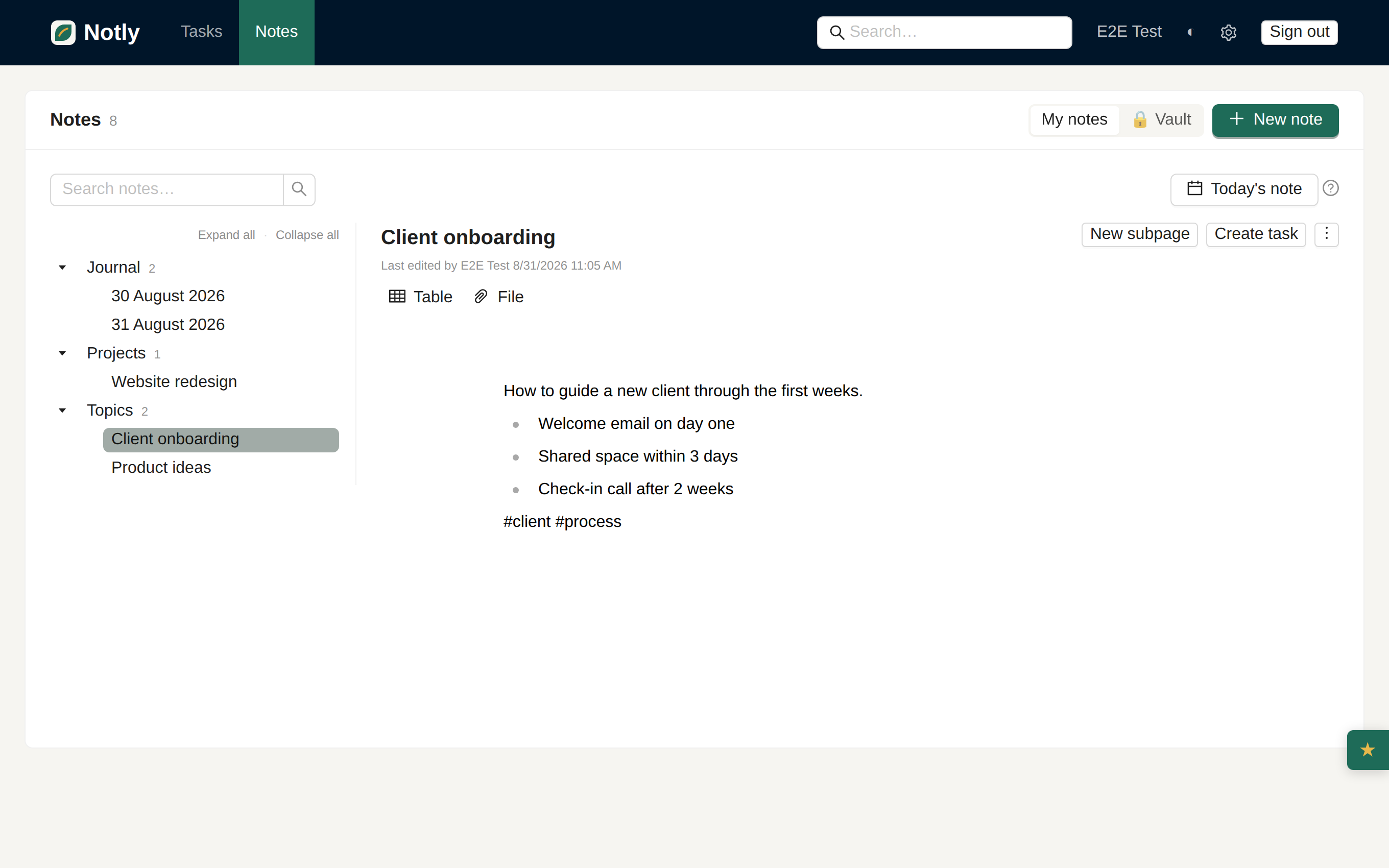
In Notly this comes naturally, because notes and the links between them live in one place, and a permanent note can link straight to the task it’s actually about. For a practical look at building that kind of space, see the article on structuring your notes; for the habit that keeps you writing into it past month one, see the one on organising your notes.
Say you come across a line in a book about the Zeigarnik effect — the finding that we remember unfinished tasks better than finished ones, because an unfinished thing keeps a kind of tension active in your head.
Zettelkasten was never really about index cards or a ritual — it’s a way of building a network out of small, individual ideas that hands connections back to you on its own. Write atomically, keep fleeting, literature and permanent notes separate, and above all: link. A new idea doesn’t gain value by landing in the right place — it gains value by bumping into an old one.